Pirates Vs. Pirates

Featured

Tags

, , , , , , , , , , , , , ,

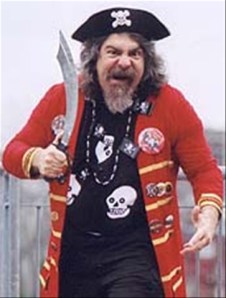
pirateOne thing I love about contemporary life is that people like to do social, frivolous things in order to escape the dreary realities of day-to-day living.  One of my personal favorites is the “holiday” called “International Talk Like a Pirate Day”, held annually on September 19th. It’s a modern phenomenon, born on the Internet and assisted in popularity by syndicated columnist Dave Barry.  And September 19th also happens to be my birthday.  Arrr!

On this day, everyone is supposed to talk like a pirate, saying things like, “Arggh, ye wench!  Fetch me my vittles!” (to your wife), or, “Avast, ye scurvy chumbucket!  I dare ya to dispatch yet another memo across my desk!” (to your boss).  Alas, there is no pirate term for ‘memo’.  And although these statements may cause you the loss of your marriage or your job, they are so much fun to say!  Challenge your friends!  Enjoy the holiday fully!  Accessorize by wearing pirate garb to work.  Those with time on their hands (or people like me who are easily led into excuses for socialization) may host festive parties where everyone drinks vast quantities of rum, grog, and mead and shares in the celebration of all things piratey.

When we think of pirates, we think of ships festooned with smiling skull-and-crossbone flags, of wise-cracking faithful parrots, gallons of rum, hefty wooden sea chests burgeoning with jewels and gold coins, and tattooed men bearing eye patches, hooks for hands, and legs of wood.  We indulge in cute Internet role-playing games such as Puzzle Pirates. We picture the handsome Johnny Depp in his role in the Disney trilogy, Pirates of the Caribbean, rakishly wooing an elusive damsel on the mainland.

These are joyous, escapist things that everyone likes.  The aforementioned hand-crafted prosthetics of a pirate suggest injuries incurred during a great, spiraling tempest while he battled the winds and seas with a great degree of manliness, or perhaps during an intense physical battle with a mysterious tough-guy.

“Say, Jim, how’d ya get that wooden leg?”

“Arrrgh.  T’was when I fought hand-to-hand with the fearsome Bluebeard on the high seas.  Carved me up with his sword, he did, and tossed me real leg overboard.  But I jumped, bloodied and scathed, into the frigid waters of the Atlantic, and pummeled with me fists the swarms of sharks who tried to ravage me whilst I swam through fifty foot waves for four hundred miles to a deserted island in order to save me own life. All while carrying a hundred pounds of gold coins, mind ye. And I didn’t drop a cent.”

Whew! Who wouldn’t be impressed?

Fictional pirates add fuel to the fire of these lighthearted images.  Smee and Hook were the bumbling pirates in Peter Pan who somehow managed to do nothing right.  If you read the original novel by J.M. Barrie, “Peter and Wendy”, there is a deep psychological facet to these pirate characters that literary scholars debate about endlessly, but in the end they got what was coming to them. In the cartoon movie, they (along with their crew) are portrayed as a collective of stereotypical yet impotent pirates who managed to elicit the young viewer’s sympathy because they aren’t really dangerous, and after all, they can be bested by the good guys.  And Long John Silver? Well, he has a chain of fish stick restaurants in the South now, doesn’t he?

However, the reality of a pirate is quite different than the romanticized version most people have.  There is a skewed sense of just exactly what an “old-school” pirate was.  History blurs.  It is important that we separate fact from fancy and understand our own perception of a pirate. Romanticized pirates were “every-guy” black sheep heroes, like Robin Hood or Jesse James.  Sure, they took stuff, but it belonged to rich folks who didn’t deserve their privileged lives.  And didn’t the aristocracy screw them over in the first place, setting them off on the path of piracy as a calling?  Didn’t they share their loot with all their friends, and secretly help widows and orphans?  Yes!  We all want to imagine ourselves having the balls to take such a daring and independent road to paydirt glory.  People will fear us.  And they will talk about us.  And they shall embellish!

In real life, Jean Lafitte was a slave trader who cheated on his wife, and a mere merchant who dealt in stolen goods out of a shop on Royal Street in New Orleans.  It is rumored that his death came at the hands of his own men.  The exploits of the notorious Blackbeard (nee Edward Teach) were largely hyperbole… his chief weapon was fear.  Fear and surprise.  Okay, that’s two weapons… surprise and fear.  And ruthless efficiency… okay threeAmongst his weapons were…  never mind.  Sorry, that’s Monty Python’s Spanish Inquisition, albeit a similar collective gang of rogues.  But in reality, Mr. Teach/Blackbeard never even killed a single person.  He was also an inept seaman who ran two of his own ships aground, a drug addict who demanded ‘medicine’ as a ransom for his hostages, and a bigamist.  He was subsequently killed in a sword fight by a North Carolina lieutenant named Robert Maynard, who hung Teach’s severed head from the bowsprit of his own ship. Very terrifying indeed.

It’s great to have fun with “Talk Like a Pirate Day” (I make my high school students participate each year if it falls on a school day).  It’s also quite fun to play online games such as Puzzle Pirates, and it’s great to enjoy Depp’s portrayal of Jack Sparrow in the movies.  Those are the fantasy pirates, the ones who entertain, the ones who bring teenage girls, frustrated soccer moms, and bi-curious metro-sexuals to their knees.

But real pirates, especially modern day pirates, are hideous and they probably stink to the high heavens, too.  How many showers do you think pirates take while hiding out from the law on the high seas, crammed into a leaky vessel with fifteen other men, not able to come ashore due to the lack of proper paperwork?

A quick Googling of the word “pirates” will bring up a results list which includes an MLB baseball team, a Disney feature film, the ubiquitous Wikipedia definition entry, a video of two men who created a pseudo-holiday, and an Associated Press news story about the horrible real-life modern day pirates off the coast of Africa.  WAIT… Why on earth did the inland city of Pittsburgh name its Major League Baseball team “The Pirates” anyway?  Surely there is no huge history of seafaring lore on the border of Pennsylvania and Ohio.  No, there is not. They became the Pirates because in 1890, the Pittsburgh Alleghenies (their original name) stole, or “pirated”, second baseman Louis Bierbauer away from the Philadelphia Athletics and were subsequently renamed The Pittsburgh Pirates. A name of which to be proud, surely.

Webster’s Collegiate Dictionary defines “piracy” as:  “… an illegal act of violence, detention, or plunder committed on the high seas for private ends…”.  Violence?  Plunder?  Hmm… Nothing about devilishly handsome adventurers with an endless supply of 180 proof Jamaican rum enjoying a few months at sea with “the boys”?

The more recent bloody demise of three modern-day pirates from Somalia (who in the end were unsuccessful at attacking an American-flagged ship, The Maersk Alabama) was a satisfying ending to an infuriating scene which played out on the televisions of the civilized world.  Three scrawny little bastards who preferred to try to intimidate working men and steal things that don’t belong to them over bettering themselves through education. Take THAT! (sound of gunfire).  Three shots from three U.S. Navy SEALS from a cubbyhole on a moving ship at a moving target… and hey, sorry, but you guys are instantly dead.  Hooray for Navy heroes everywhere.  We take back our seas, dammit, so don’t fuck with us.

REAL pirates are ALL bad guys.

But who doesn’t like to break into a chorus of that famous old sea shanty?   “Fifteen men on a dead man’s chest… Yo-ho-ho and a bottle of rum! Drink and the devil have done for the rest… Yo-ho-ho and a bottle of rum.”  You simply can NOT sing that song without raising your arm in a festive glass-clinking gesture while holding an imaginary bottle of rum.  But wait, what does ‘the devil’ have to do with this?  I want to know more…

Well, here are some fun facts: The name of the original song is “Dead Man’s Chest”, originally pieced from Robert Louis Stevenson’s “Treasure Island“. Later, it was expanded into a poem entitled “Derelict” by Young E. Allison. How many of us know any other lines?

“…The mate was fixed by the bosun’s pike
The bosun brained with a marlinspike
And cookey’s throat was marked belike
It had been gripped by fingers ten;
And there they lay, all good dead men
Like break o’day in a boozing ken

Fifteen men of the whole ship’s list
Yo ho ho and a bottle of rum!
Dead and be damned and the rest gone whist!
Yo ho ho and a bottle of rum!
The skipper lay with his nob in gore
Where the scullion’s axe his cheek had shore
And the scullion he was stabbed four times four
And there they lay, and the soggy skies
Dripped down in up-staring eyes
In murk sunset and foul sunrise
Yo ho ho and a bottle of rum.

Ah, clarity.  While surveying the scene more closely, we see that these men are strewn about the boat in a murky drizzle while the raindrops fall into their still-open (but dead) eyeballs.  There is booze.  People have been damned.  The mate had been killed by a pike-wielding bosun.  The bosun then had his head rammed (clear through to his brains) with yet another eight-inch-long spike.  The cook had been viciously strangled in hand-to-hand combat (with both hands).  The skipper, laying in bloody gore, got hacked with an axe (in the face!).  And the guy who hacked him apparently met his own demise by being stabbed, not just once or twice, but sixteen times (if my math is accurate).  Dead and damned, all of them.

Wait. What do you mean?  Where are all the sparkly gold doubloons?  Where’s the romantic departing kiss from the dashing Captain Sparrow as he swings out from the ropes of the mainsail onto his own ship and heads out to sea?  Where are all the jocular parrots and the high-spirited shenanigans?

This is a catchy song we teach our costumed ten-year-old boys, bedecked with plastic swords and goodie sacks, to sing with their friends while out begging neighbors for candy (and threatening those same neighbors with evil tricks if they don’t hand over the loot… which does resemble piracy, but Halloween is a blog for another day).

In reality, pirates are jerks.  Modern-day pirates are a vicious scourge on society, the potential bane of good hard-working seafaring men, as were the pirates of yesteryear.  The modern day pirate is nothing more than an unemployed opportunist who can’t qualify for a job at the local Quickie Mart. They are ugly, selfish, lazy criminals who would rather steal than work for a living, and have no qualms about kidnapping, torturing, and killing whomever gets in the way of their haul.

But imaginary pirates and historically inaccurate legends of pirates are a thing to embrace. Seriously… show us the real ending to the story of that song.  Are there any survivors? Do some of these guys wake up the next morning with massive hangovers, bemoaning the mess they made?    Here’s the script:

Yo-ho-ho

ACT III:  final scene

Invasive, headache-inducing bright sunlight is rising above the horizon on a calm sea.  Pan to to the ship’s broken mainmast with flapping sail. Cue squawking lone seagull. Zoom in on disheveled twenty-something, rubbing head in obvious pain as he rises awkwardly from a restless sleep from under torn jib sail.

Disheveled twentysomething:  (holding empty gallon-sized Bacardi bottle, his face clearly showing expressions of anger and disgust)  “Oh my god, you guys… we drank all the rum!  (now points to broken hinge) And who broke the lock on the hatch?  (now shows expression of dismay) Oh, great… look at that! WHO sliced Mike’s throat with a scallop shell?  (begins to point around randomly) And who the hell are all these other dead guys?  Who invited them?”

Second disheveled twentysomething, groaning, off-camera:  “Shut up, Glen. It’s nine o’clock in the morning.”

First disheveled twenty-something (first bending, then standing, now holding large pointy swordlike object):  “Okay, WHO brought the marlinspike?!  We’re not doing any 17th century ropework here! (throws object to the deck in disgust) Dammit!  You guys better help me clean up all this blood! (raises empty hands to the sky in desperation) Did we bring any OxyClean?”

Lone seagull:  “Cawrk!  Cawrk!”

Fade.

Mentions:

Dead Man’s Chest”, or “Derelict“;  Stevenson, R.L., “Treasure Island”; 1883 and Young E. Allison

http://talklikeapirate.com

Peter and Wendy“, Barrie, J.M.; 1911

http://www.puzzlepirates.com

MLB (c) and their subdivision affiliates, the Pittsburg Pirates (c) had nothing to do with the creation of this article.  In fact, they’d probably hate it.  Which makes me happy, as I am a life-long Boston RED SOX fan.

 

Budgeting for Your Life

Featured

Tags

, , , , , , , ,

A Hingham firefighter puts his life on the line to save man's best friend.

Hingham, Massachusetts:  February 7, 2009

“…Firefighters were called to World’s End, a park on Hingham Harbor, shortly after 9 a.m.  They found a black Labrador that had gone 300 feet out before falling through the ice.  Wearing cold water rescue suits, firefighters battled their way through ice and slush to reach the dog.  Two firefighters went out to the dog, while a third assisted them near shore, said Fire Captain Joseph Mortland.  … Fire officials said they perform such rescues so people will not endanger themselves by trying to save their pets. But the rescues are still hazardous…”     – The Boston Globe, at Boston.com

To put your life on the line to save a struggling animal is an honorable thing. This story is just one example of why cities and towns across the state should place every priority on funding fire departments to their fullest.  That rescue could have just as likely been someone’s child.

These men were well-trained and had the right gear (cold water rescue suits) to get the job done as safely as possible. All firefighters should have all of the proper equipment, training, and staffing that they need.   A real life rescue such as this can also be considered “on-the-job training”.  It is a shame that some people think that fire departments (as well as police and teachers) should be the first place to chop when considering budget cuts.

I would bet my last dollar that even if they did not have the right equipment, any firefighter would have attempted the rescue regardless, because it comes naturally to them, and as they themselves will tell you, “I’m just doing my job.” And sadly, not having that equipment could have cost them their lives.

I’m sure there will be nay-sayers who will rant on, saying “all that for a DOG?”  and “what a waste of money” etc., trying to incite an argument or put their narrow-minded opinions forth.  But I want them to think:  When your time comes (and in this crazy world we live in these days, the odds are it WILL come), when you need a firefighter to assist you or save someone or something you love dearly, you will thank god that those firemen had all the training and equipment they needed, and that they were THERE for you when you needed help most.

It is our responsibility to protect firefighters and provide for them as they protect us.

Imagine this ironic possibility:

A local citizen  lives in a modest home on a regular street in an average neighborhood.  He reads the story of the Hingham Harbor dog rescue with interest, because he sees this as an opportunity to exploit what he considers to be a perfect example of how he can “save his town” and reduce spending.  This citizen becomes instrumental in convincing his townspeople and neighbors NOT to vote for a Proposition 2 1/2 override, saying “we can cut out much of the ‘unnecessary’ monies going to the fire department.”   He then used the story of the dog’s rescue as an example of “wasting money” and how “silly and useless” it was for a town’s resources to have been spent in such a way.  After all, it was “just a dog.”

It is late in the evening, next summer.  That citizen is home by himself having a couple of drinks while watching a late-night movie before going to bed.  He turns off his HDTV and heads upstairs to his comfortable and well-appointed bedroom for some much-needed sleep.  A few hours later, he is roused from his sleep by the incessant barking of his neighbor’s dog.  He says to himself, “SEE?  Why the hell would anyone waste all that money and manpower to save a damned dog… like this one who is right under my window in the middle of the night, barking and scratching and being a pain in the ass… waking me up from a perfectly good sleep!  I’m going next door right now and give that neighbor an earful of shit.  It’s three o’clock in the morning, for chrissake!”

And as Mr. Citizen opens his bedroom door, he sees the blazing orange glow of his living room on fire.  He feels the intense heat.  He begins to choke on the thick black smoke that is engulfing his home.  And as he drops to his knees gasping for oxygen, his heart racing in panic, he continues to hear the neighbor’s barking dog, who is still outside barking and scratching at his door in that natural, undiscriminating protectiveness of Man’s Best Friend.   The man gropes for his cell phone and blindly dials 9-1-1.  He feels the raging fire’s incredible heat on the back of his neck as he throws open his bedroom window and wonders if he should jump.

But the fire department arrives.  In seconds, the first men on the scene assess the situation:  The man on the Engine lays down a length of hose and opens a hydrant.  His rider grabs the nozzle and instantly begins to knock down the heat and flames.  The driver of the Ladder truck positions his vehicle just right, and puts the gears in motion to extend the ladder, while his partner climbs toward the burning and panicking citizen at the window.   The Fire Captain on the ground,  conducting the symphony of the rescue, uses all of his training to properly direct every movement of his men… without a shred of contempt or a moment of suspicion in considering whose life they are about to save.

And the waiting paramedics in the ambulance do all they can to quickly prepare their gear and supplies, so that they may be ready in a split second to administer the necessary first aid to the man they know is going to be pulled from harm’s way and delivered to them safely.

The ambulance pulls away, headed to the hospital with the man inside.   His home has not been destroyed.  After all, he has insurance, and he is happy to be alive.  Panic and shock still show in his eyes, and he is afraid he might be having a heart attack.  The  attending paramedic runs an IV and looks at the citizen.  He wipes a cold compress over the man’s heated skin and encourages him, “Don’t worry, you’re going to make it, Buddy.  Hang in there. I’m right here with you.”

The rest of the firefighters continue their job at the scene, cooling the embers, checking for hotspots, cleaning debris, and surveying the home they saved from complete destruction. The firefighter who climbed the ladder cools the minor first degree burns on his ears with the spray from a leak in a length of hose.

The beautiful dog who instinctively barked his life-saving alarm trots happily over the scattered hoses and growing puddles.  One of the firefighters removes his heavy turnout coat.  He pulls his helmet and Nomex hood from his head and wipes his sooty brow with the back of his forearm.  He sees the dog approaching, and stoops to scratch behind the ears of the friendly pup.  The man and animal look into each other’s eyes and there is an understanding between them:   They have done something good tonight.  They understand each other well, because goodness and decency are recognizable qualities.  And, because this man and this dog have met before… last winter on the slushy frozen bay of Hingham Harbor.

Mr. Citizen will live to vote another day.


Brockton Mass 1970’s

Featured

Tags

, , , ,

My sister and me.  circa 1974

My sister and me. circa 1974

I went to Ellis Brett Elementary School from 1970 to 1976 (except for fourth grade, when I went to the then-called “Goddard School” (for the AP kids). Then I attended West Junior High until ’78. My parents divorced and we moved to Randolph with our Mom at the end of my 8th grade year. So, a miserable year in Randolph in 9th grade, Archbishop Williams for 10th and 11th grade, then finally to Brockton High School for senior year, back with my old friends to graduate in ’82 together.

Our Elementary school was the Ellis Brett School on the West side, near a back entrance to D.W. Field Park. We never called it “the Brett school”, or “EB” or anything shortened… always “Ellis Brett”, pronounced by everyone as one word with an ‘s-p’ instead of a ‘B’, as in, “Ellisprett.”

At Ellis Brett, first, second, and third grades were on the first floor; fourth, fifth, and sixth were on the second floor, as was the principal’s office and the nurse, two classrooms per grade. I remember some of our teachers: Miss Barbara Lyons, Miss Quan, Mrs. Carridi, Miss Yarletts, and Mr. Alan Jolly. Mrs Sneirson was a third grade teacher who looked exactly like Cher, to us anyway.

We had some kind of an audio-visual closet we called the “A/V room” on the first floor, where the overhead projectors were kept – very high-tech for 1973. Some of the teachers would let us run off papers on the mimeograph, that cylindric hand-crank machine that grinded out violet toned copies, and we would return to class with our hands all purple from the ink and carbon paper. Anyone who was in Miss Lyons’ class will remember that interesting musical instrument, the “autoharp”. Whenever Miss Lyons got out the autoharp for music class I was thrilled. Fascinated by this interesting musical instrument, I vowed to own one and learn how to play it some day. Maybe it’s not too late.

We had to go down to the basement to get our milk during lunch, because we didn’t have a cafeteria (milk went from three to five cents when we were in the third grade). And because we also didn’t have a gym, our recess was outdoors on the “blacktop”, but whenever it rained we had “indoor recess” where we pushed our desks to the sides of the room and played dodge ball right there in the classroom. Occasionally Mr. Boutin, the gym teacher, would break out the “batacas”, those big red overstuffed bats you were supposed to hit a ball with, but we usually ended up just beating the shit out of each other instead.

I also remember Mrs. Daversa, I think she was a lunch monitor. She once yelled at me, Jennifer Shinnick, and Leslie Kram, because we were “bold”, and made us stand against the wall for recess… the big punishment for us kids at Ellis Brett in the 70’s. Fred Hebshie hung around with all the Jewish kids (there were only about five Jewish kids in our class at the time), and I always thought he was Jewish, too, until I ran into him years later as an adult. I saw him one day during the holiday season while he was managing a large grocery store. I said, “Hey, Fred! Happy Hannukah!” He looked at me and said, “Why does everybody think I’m Jewish?” We both cracked up laughing. We were all too young to date back then, but boys and girls had that typical kid-crush going on. I think Fred had a crush on Erin Clancy, Erin had a crush on Jon Weiner, I had a crush on Steven Cardinal, and Chuckie DeStefano had a crush on me. Steven Cardinal moved away in our sixth grade year. Me, Ginny Mara, Joan Conley, Patti Comeau and a few others were in the same Brownie troupe. Ginny used to say she hated her middle name, because it was more of a last name than a ‘real’ name. It was “Foss”. That always stuck in my head. I always thought Virginia was a beautiful name, so that balanced it out.

Marshall Anderson came to Ellis Brett during the third grade. He moved into Kim Vallaincourt’s old house on Ash Street. He had a very charming personality, and Marshall and I were instantly great friends; we still are. I think Marshall is still friends with everyone.

Erin and I were the shortest kids in the school – Miss Lyons used to measure us every day on the wall in the classroom. I remember Jeffrey Benefit (he was a grade younger than us) was one of the best kickball players ever to attend our little 12-room school. Linda Baroncelli was the best athlete out of us girls, and she could give any of the boys a run for their money in kickball, softball, or even a foot race. She used to wear one of those sailor’s rope bracelets, and I thought she was so cool because she was left-handed. John Verminck was double-jointed and could bend his arm backwards at the elbow. He also used to bring little containers of ketchup for lunch and just eat that with a spoon. Steven Noel and Steven Cardinal used to say, “WHOA-dett!” all the time. I have no idea why.

Near the corner of Pleasant and Ash Streets there were several shops we frequented near our beloved “Ellisprett”.  Dunnington’s Pharmacy was right on the corner, and it was where all us kids from “around the blocks” went to run errands for our parents. In my case, I’d run up with seventy-five cents in my hand to get my Dad a pack of True blue cigarettes, which were fifty cents a pack. Yes, times were simpler back then, and kids could happily buy cigarettes and probably anything else without having to go through federal government background checks. I got to keep the remaining quarter and usually bought a Butterfinger candy bar with that. Then there was Mrs. Foster’s candy store, and after school we’d all go there for penny candy. At Mrs. Foster’s, you could fill up a little brown paper sack with all kinds of penny candy… paper strips of candy dots, hot balls, root beer barrels, and wax drinks. There were also these weird little candies shaped like UFOs called ‘flying saucers’, that were basically two pieces of styrofoam filled with tiny BB’s. They tasted like communion wafers and sometimes got stuck on the roof of your mouth. Mrs. Foster’s later became Moraine Variety, and somehow it just wasn’t the same. Cassani’s Restaurant was also a big hit, and it was special to us because we knew Michael Cassani, and his family owned it. They had the absolute BEST Italian meatball subs ever.

We went Downtown to go to Saint Patrick’s for church.  The Y was there, and many of us had families who joined. We’d see each other at the pool, or at craft fairs, or any one of our CCD sporting events that were held there. The Brockton City Hall and the Brockton Public Library were two of the most beautiful buildings in the whole city. To me, as a kid, they were luxurious examples of brick and wood and artwork. We shopped over at the end of Belmont Ave at a discount department store called King’s, and across from that was the Brockton Public Market, or “BPM”, as we called it, where we got our groceries. My Dad worked at Central Fire Station on the corner of Pleasant and Main. He was a fireman on Squad A for the Brockton Fire Department and when I’d go to the station with my friends, the guys let us climb all over the “hook and ladder” truck.

At one very disturbing time in this era (1974), a little boy named David Louison disappeared, and it became national news. Every elementary school in the country began a massive safety campaign to educate us naïve youngsters on personal safety and “stranger danger.” Sadly, the little Louison boy’s remains were found in an abandoned building six years later. I will never forget David, or the echoes of all the voices calling his name for weeks. I believe his father eventually became instrumental in the “Missing Children” pictures on the milk cartons. Thus began our journey toward reality and growing up in the modern age.

At West Junior High, I remember Mr. Nax, Mr. Socarides (how old was he, anyway?), and Mr. Dahlborg, the science teacher. Homerooms were alphabetical by last name, so poor David Clisbee had to sit between Erin Clancy and me, passing our notes back and forth through him. Someone put tacks on Mr. Nax’s chair on April Fool’s Day, obviously an inventive and creative student who I’m sure became a diplomat or a foreign affairs secretary.  Our science class was alphabetical, too, and that’s where I met the Michaels, two best friends with the same name. Seating went Michael Anderson, Michael Berolini, Mimi DiGiammo… so the three of us became lab partners and ultimately pretty good friends.   How we came to hang around with Amy Smith, I can’t recall, but I have a great picture of the four of us standing in front of the chalkboard… wearing very 70’s clothing. If I can find it, I will post it here.

The Ash Street playground was a great place to let off steam and run free. There was no cushioned mulch on the ground to break our falls… just rocks, dirt, and concrete. There were no low temperature plastic curvy slides, just a standard metal straight slide that I think was about eight feet high which was hot as hell in the sun and if you slid down it in the summer wearing shorts, the burns on your legs lasted for days. A rusted set of metal monkey bars, a large swing set with metal chains and wooden seats, two flat planks of wood with handles that passed for see-saws,  and a metal and wood “spin-out” rounded out the playground equipment. The splinters, burns, skinned knees, twisted ankles, and broken wrists were all part of growing up. 

We never came in the house until well after the “arc-lights” had come on. The corner of Spring Street and Belmont Ave. used to be a dangerous intersection and the scene of many car accidents in those days prior to the now-present traffic signs. Walking to school with our friends down West Elm Street with West Junior High waiting proudly at the end was always great fun. It was beautiful in any season, but I remember vividly when they let us out of school early during the start of the Blizzard of ’78 just how amazing a tree-lined residential street is when covered in fresh white snow, especially a street dotted with large Victorian homes. Pat, Hugh, Danny, Joann, MaryTeresa, Georgette, Phil, and so many others came into my life at West Junior High. When we were in the 7th grade, Jay McGee’s older brother Skippy, who was in the 8th, had a huge after-school fight with another big kid named Evan Young. The ongoing battle seemed to last all year. I’m fairly sure they fought at least three times that year, those good, innocent times when a fight meant a fist fight, not “bring your own guns and knives.”

I had my first date that same year, with Billy McCann, who got his picture in the paper because he turned 13 on Friday the 13th… May 13th, to be exact, another gem that has stuck in my head for eternity. We went to see “Rocky” at the Westgate Mall Cinema. Movie tickets had just increased in price to $1.25. My father wouldn’t let me call boys on the phone, and a few weeks later, Billy sent his friend Tommy Sturdevant to my locker to break up with me. He said it was because I never called him. Darlene Masefield and I tried out for the WJH cheerleaders, then quit when we realized we had to wear those little skirts and stand around in the cold. I was sad when my parents got divorced and I had to leave Brockton to move to a new town.

It was nice for me to be able to come back and graduate as a senior from Brockton High. Most of our West Junior High pals went on to be high school superstars – excelling in everything from sports to school government. I think Pat Cesarini was everything… handsome football player, class President, National Honor Society… but he was always so humble and modest and quiet. I think in our yearbook under his picture he wrote something minimal and vague, like “student government and athletics”. I used to think Mary Santry and Eileen Cashin were going to come back as Principal and Vice Principal some day. Jay McGee was going to be the next Tony Dorsett, we were sure.  BHS Boxer running back #21 could bounce and zing off opposing defenses like a pinball, and was destined for greatness.  We were lucky to have such a large, talented, diverse group of classmates. Having an unusual nickname like “Mimi” was unique to me… until BHS. There were at least three “Mimi”s in the class of ’82: Mimi Uhlman, Mimi Boutas, and myself; our real names were Mary, Demetria, and Marianna. I wish I had a dollar for every time someone has said to me, “Oh, you graduated from Brockton High in ’82? Do you know So-and-So?” With about 1,200 seniors in our graduating class, we couldn’t possibly have known everybody.

During our senior year, my sister-in-law Elaine was also in our class of ’82. I was married and had a baby son named Ryan who was one year old during our senior year. I used to bring him to school sometimes (Mr. Bethany always let me bring him to our Sociology class… what a great class – no books, just discussion… and lots of it. Marie Murphy and I had a great time). I took three foreign languages in senior year… Dr. Taconet became one of my favorite teachers. I also took the swimming test in September to get out of having to take swimming for gym during the school year. I took archery for one of my gym electives and had this great gym teacher who was really cool and sexy named Carlyn Gombar. As my mom, “Mrs. D” was a popular English teacher in the yellow building, she and Carlyn became best friends. For years I was still able to see the fitness and style this lady exuded. Carlyn gave me the best 30th birthday card ever. It said, “The best is yet to come.” She was right, and I still have that card. Sadly, she later passed away from pancreatic cancer. What an amazing school we had: an indoor pool, a planetarium, a hockey rink, a full-blown Fine Arts building with a stage and gallery… we got used to walking about a quarter of a mile in between each class. I remember thinking six minutes was not enough time between “mods”.

Another class I had that year was Oceanography with Mr. Bohlin, who, on the first day of school, walked in the room, broke out a record player, and played “The Tide is High” by Blondie. Cindy Jones and I sat next to each other, and we thought, ‘this is going to be interesting’. I used to talk with Eric Lutz on the phone at least once a week, but we hardly ever saw each other in school. Eric was so smart, and we had many intellectual conversations that were, of course, of great importance to the future of the world. There were so many of us, and there were four separate buildings of homerooms, there was no way everyone could see everyone every day.

Because I was a mom, I didn’t participate in a lot of the normal senior year activities, so I don’t have a lot of pictures of parties and events. I did go to every football game, though. I’ve been a sports fan all my life, and our Boxers owned high school football in those days! We were champions so many times, other schools didn’t want to play us anymore. Eventually, a whole new Conference was created called “The Big Three” which included New Bedford and Durfee as well as Brockton High.

Just a few short years after graduation, Steven “Buck” Noel died tragically. Steven was the Captain of the BHS basketball team, a member of the BHS TV station, and had an extraordinary creative mind. He used to share his poetry and drawings with me. Before he died, he used to stop over and visit with me and my two little kids, telling them funny stories from when we were in elementary school. I remember those times fondly. I was devastated when I heard that he took his own life. Sadly, I missed his wake because in back then, I didn’t read the paper (who did?), and those days were before cell phones and Internet. Steven was a good old friend. [Note: Buck’s sister has graciously given us her corrected version of this statement in the comments section, see below.]

I have remained in touch with many good friends from the old Brockton days. I’m still friends with Erin Clancy, stayed in touch with Mary Santry, and I still hang out with Jay McGee. We’ve been best friends since we were 12 years old. Jay and I have stayed in touch with our old pal Phil Russell (who moved to Los Angeles in the 90’s) and still stay in touch with Chuckie Tartaglia and Marshall Anderson. Pam Kennedy and I never really knew each other in high school, but thanks to class reunions and ad-hoc get togethers over the years, we’ve become very close friends. And thanks to Facebook, other social media outlets, and the hard work by our alumni like Hugh McLoughlin, Georgette Sarkisian, Mary Teresa and many others, I think our Class of ’82 has one of the best online presences of all time.

Several years ago, Geoffrey Gouveia also passed away. A BHS football player and wrestling Captain, Jeff was a big bear of a guy. His love of life was huge, and unfortunately his appetite for living got the best of him… too much of what was available in life finally squeezed the life out of Jeff. I have a great photo that I took of Jay, Jeff, Phil, and Chuckie, sitting in a wooden booth in the first bar at George’s Café on a Thursday night, Bud bottles covering the table, chests puffed out, college t-shirts proudly worn, framed Brockton memorabilia on the walls. I still pop into George’s Cafe as often as I can, and say hi to the owner, Charley, Chuckie’s Dad. George’s Cafe is a Brockton must, as is Christo’s Restaurant, also owned and operated by another ’82 alum, our good friend, Georgia Tsaganis.  Her dad and my dad and Chuckie’s dad were all good friends too, back in the day.

Brockton has seen a decline once or twice in this century, and Brockton will rise again. I feel sad that Brockton gets a bad reputation from some of the more sensational things that find their way into our media. There is a lot of history in Brockton, and much to celebrate about the “Shoe City” and the “City of Champions.” From our hometown boxers, Rocky Marciano to Marvelous Marvin Hagler, with Ken McAfee, Rudy Harris, and Rich Miano (our NFL players), and the Can-Am League professional baseball team, The Brockton Rox, Brockton is a sports town steeped in victory and tradition. And it was, and still is, a family town.

I am proud that I grew up there.  I feel honored to have had the good fortune to be raised safely by blue-collar parents who valued my education and played a vital role in a hard-working town. I am thankful that I had the good fortune of being brought up with so many different people from so many different cultures, backgrounds, and interests.  Brockton, Massachusetts is an intrinsic part of me. Many of our friends have relocated, but many remain. Brockton stays alive in all of us. Thank you Brockton and Brockton friends for so many great memories!

{Since this article was first written, we have also lost two other friends whose names appeared – Chuckie Tartaglia and Eileen Cashin. Our Class of ’82 bond will always be with their families, and the families of all our graduates who have since passed away.}

Please Polish the Silver

Tags

, , , , , , , , ,

The 2008 Olympics is rife with two disappointing trends:  The individual athlete is forgetting his pride of nation, and somehow it has become a tragedy when an athlete comes in second.  Do we blame the media for showcasing only the victories of gold medal winners, or for being guilty of preconceived expectations of our own country?  Perhaps we should take the blame ourselves for living in an age where we have allowed a culture of “me-ism.”  Have we put aside our sense of patriotism and become jaded by world politics, forgetting about the true spirit of the Olympic Games, and the sheer joy of athletic competitions?

If the media’s take is such that what really counts is individual medals and records, then why keep track of the number of total medals each country has won, why march with the rest of your countrymen during opening ceremonies, why have the host country put on million-dollar displays of its nation’s culture and history?   What’s next for the summer Olympics of the future… personal theme songs instead of national anthems for the gold medalists?

I was saddened to watch a part of the outcome of the men’s 100 meter sprint and to witness the dejection of Jamaican runner Asafa Powell because of his fifth-place non-medal finish.  His countryman, Usain Bolt, took home the gold for Jamaica and easily obliterated a world record in the process.  It was a treat to watch Usain “Lightning” Bolt run this race, to watch with amazement as he incredibly decelerated with fifteen meters to go and pounded his chest in victory, ultimately leaving room to easily break his own new world record.  But instantly, my excitement at having witnessed such a feat was dampened by the disappointment and non-congratulatory carriage of Mr. Powell.

I understand the basic human emotion of not achieving, call it ‘losing’ if you must, and raw emotion is a very difficult thing to mask.  I also fully understand the sadness experienced by individual athletes in the team competitions when they do not do as well as expected.  You, the athlete, are disappointed in yourself because you were not able to help your team and instead experienced defeat.  The converse is also true:  You, the athlete, were indeed able to help your team, because you functioned as a TEAM on your way to collective victory, witness the 1980 USA Men’s Olympic Hockey Team. However, when it comes to individual events, if you don’t place but your countryman is victorious, then revel in national pride and cheer like hell for your teammate and your homeland.

One of the marks of a true champion is to comprehend the scope of your contest, and to genuinely appreciate that contest’s victor, especially if it was not you.  Without outstanding competition, how would one be able to measure one’s own accomplishments?  If indeed the Olympic Games are an international competition with the pride of your “home team” on the line, and your teammate wins the gold, then relish in the glory which that win has brought to your country.  At least give your teammate a pat on the back in front of the cameras of the world.

Yes, it is human nature to put on a pedestal our outstanding specimens, our individual athletes who break world records and accomplish unbelievable things.  Michael Phelps was a joy to root for.  Sean Johnson was a delight to watch.  There is nothing better in sports than a true champion.  Especially if that champion is someone who, as a part of a team, makes his or her team better.  Michael Jordan.  Bobby Orr.  Reggie Jackson.  Mallory Holtman (look it up if you don’t know her).

But the Olympics is supposed to be about countries and cultures.  Nations who show the world how great they can possibly be at something that is important to them.  It is an international showcase of talent with exuberant enthusiasm on the part of each nation’s citizens.  There are surprises.  There are moments of utterly heart-breaking defeat.  And there are hundreds of stories of exceptional effort and personal bests.  Unfortunately, there is not enough air time devoted to the showcasing of sportsmanship, which is (or should be) at the heart of any athletic competition.  It should be especially showcased as an inspiration to our planet’s young people, who have grown up in a world filled with conflict, fear, and jingoistic isolationism.  The Olympic games allow us to hope.  When nations can show sportsmanship in the ultimate contest, perhaps they can show acceptance of each other while still displaying a sense of united pride.

It is depressing to watch the faces of the individuals and teams who pout and drop their shoulders in disappointment when placing second or third (still silver and bronze medalists) while not appreciating their own monumental accomplishment.  Wake up, Mr. or Ms. World Class Athlete!  You did better than the other six or seven athletes who competed in that contest, and better than the other one hundred and eighty-six other countries’ athletes who didn’t even qualify.  These are the top athletes in the world, chosen from every remote mountain and lowland, every village and town, every island, and every big city all over the planet.  And you came in number two?  That’s an achievement, not a loss.

You certainly did better than this columnist:  I can’t even make it to the fridge for another beer without getting winded.  My hopes and dreams of becoming an Olympic athlete were shattered forever when I was in the fourth grade and Walter B, the chubby kid who no one ever picked for dodgeball, beat me in a foot race during recess.  Okay, so the prize was a Reese’s peanut butter cup, and maybe Wally had more motivation than I did.  Still.  I was, at that moment, keenly aware that I could be beaten, and my false sense of superiority had been permanently deflated.  I thought perhaps I should enter the poetry contest instead next year.

Non-medalists, please do not suffer publicly like a spoiled child who did not get the last ice cream sandwich.  Go ahead and feel sorry for yourself later in the evening when you have a private moment to yourself in your room at the Olympic village.  But do yourself a favor and remember the expression we have from our great game of American football:  “Any given Sunday.”  What that means, when applied to world class athletes at international competitions, is basically that on any day you could win, or on any day you might be beaten. If you don’t come in first, today was just not your day.  You are still a champion.  Any one of a host of infinitesimal factors could have been at play here today, or perhaps that other athlete who came in one-sixtieth of a second ahead of you was just that much better… today.  You are still an athlete of enormous talent, a human being who has been able to accomplish physical excellence to get to where you are now, and well-deserved of international accolades and public adoration.

Silver and bronze medalists, take your cue from Richard Thompson of Trinidad and Tobago.  His celebration of his silver medal in that same Men’s 100 meter sprint was the singular redemption of the Olympic spirit which I, the viewer, turned on the television to see.  Had you missed the race and just tuned in, you would have bet your farm that Mr. Thompson was your gold medalist.  His arms raised in triumph, his pride of country reflected in his remarkable smile, he dropped to the ground and made turf-angels, wrapped himself in the flag of Trinidad, and pumped his fists with pride at the crowd.  And the crowd cheered.  Mr. Richard Thompson had come in second, but he medaled – the ONLY medal for his country in ANY event, in ANY sport, men’s or women’s, in this 2008 Olympics at Beijing.  I thank him for bringing back my fragile expectations of both pride of country and pride of self at having achieved second place.  I will forever remember that, and admire him for it.

Take also a lesson from the truly amazing and accomplished US swimmer, Dara Torres.  At forty-one years old, she was matched in a physical battle with the other greatest female swimmers in the world, many of whom were half her age.  She competed in her fifth Olympics.  She qualified for a particular heat, the women’s 100 meter freestyle, beating other outstanding athletes who that day did not earn the right to compete.  She entered the race and gave it her all.  She did her best, and she came in second… literally by a fingernail.  Yet she instantly swam over and congratulated the first-place swimmer because she knew what excellence had been achieved.  She smiled a genuine smile, because she knew that she had also accomplished greatness.  She was better than than the six other competitors that evening, better than the other seven billion Earthlings who did not even qualify.  And she brought home a silver medal for her country, a country which is very, very proud of her.  She stood on that podium with pride, a mere four inches lower than her golden peer, and represented her country with dignity and a true appreciation of what the Olympic spirit is supposed to be about.